Discover our Product.
Aniah boosts efficiency
and guarantees the
highest design
quality standards
It solves three unmet requirements
of high-quality chip design:
- High-accuracy transistor-level verification at full-chip scale to detect 100% of targeted errors
- Large scale deployment enabling all design engineers to fast debug design errors
- Need to cover 100% of the operating range of circuits : 100% power modes, 100% signal states
About the product
Performance
Built-in errors with optimized flow
Silicon Success
Meet our team
Maxime Rumpler
Baptiste Tournoud
Whitepapers
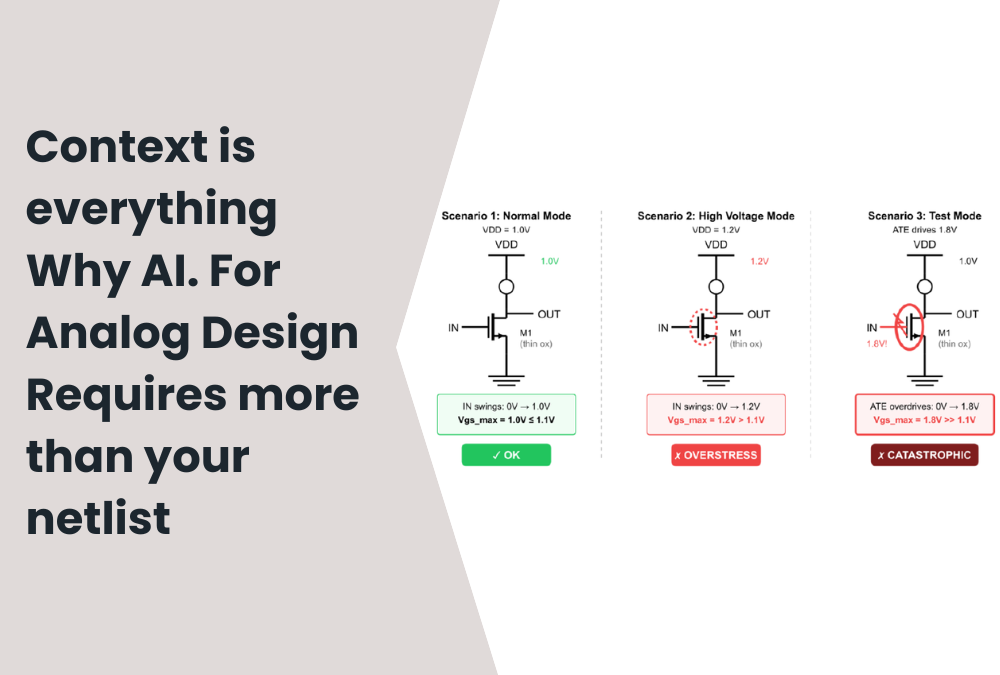
Context is everything. Why AI for analog design requires more than your netlist?
Large Language Models are transforming Electronic Design Automation, but feeding a raw netlist to an AI model cannot deliver reliable verification results. A netlist describes what is connected, not why. Design intent, power domains, operating modes, and system...
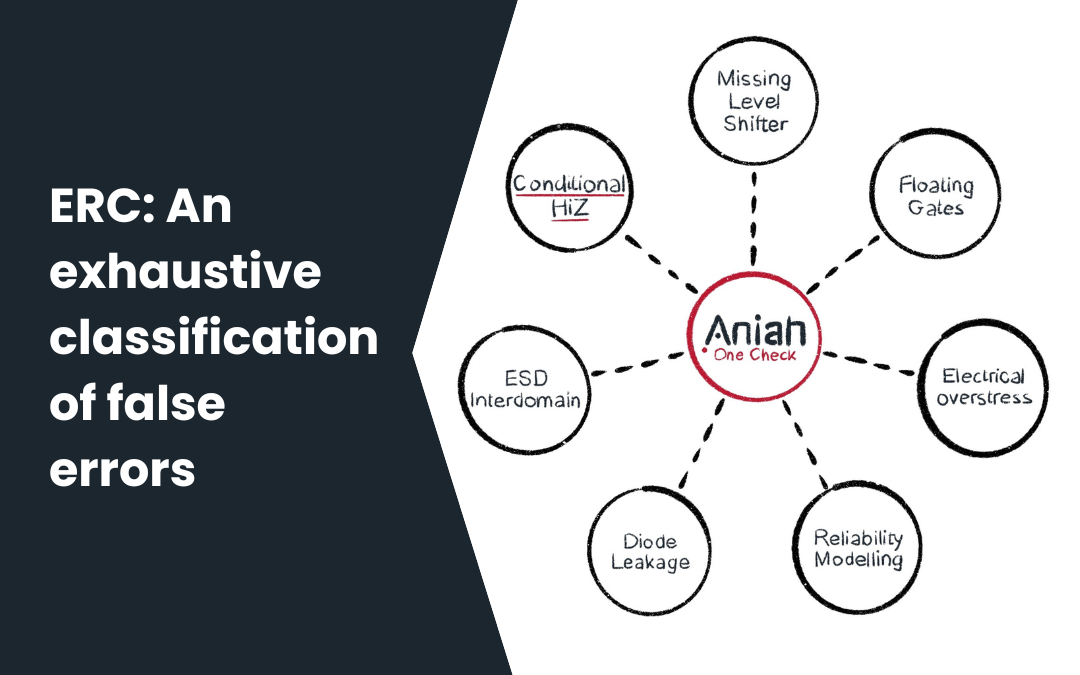
ERC: An exhaustive classification of false errors
All formal verification tools, including Electrical Rules Check (ERC), must reach a trade-off between “false negatives” (i.e., real design errors that are not detected) and “false positives” (or false errors, locations where errors are erroneously reported. This...
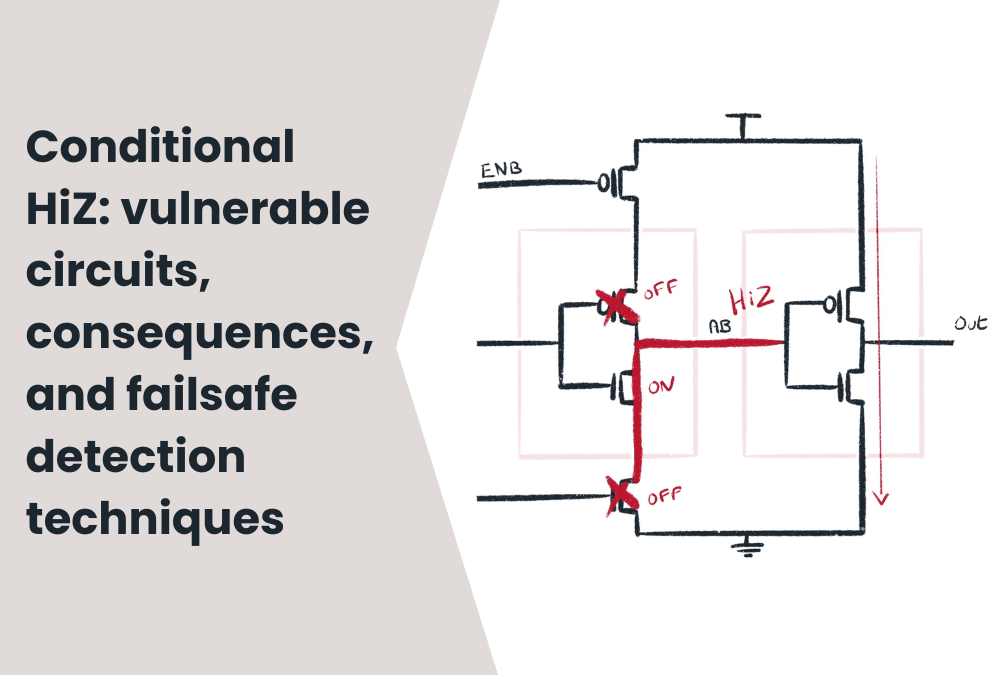
Conditional High Impedance Nets : Early detection in analog and digital topologies
Conditional high-impedance (HiZ) nets errors are among the most serious risks in an IC project because of their capacity to elude Silicon qualification phases and escape into mass-production. They may create a wide range of issues throughout the Validation,...

Magnify the Traditional Mixed-Signal Eyepatch Verification
Weeks before tapeout, SoC design teams must verify large mixed-signal transistor-level netlists. The standard approach is to verify functionality by running simulations with back-annotated gate-level RTL along with behavioral analog blocks. However, since this...

ERC: a trade-off between coverage and false positives?
Electrical Rule Checking (ERC) solutions face a double challenge: handle the billions of transistors of a chip and be accurate enough to detect all failure modes. Any solution that doesn’t have a good understanding of the function of each transistor and the electrical...

Electrical errors in ICs: why they occur and their consequences
The verification of electrical errors at chip-level has always been the missing step in chip design closure – even though a chip is, basically, a very large circuit. The complexity of such an analysis has so far made it impossible. Consequently, considerable effort is...